61st Venice Biennale
The soothing vision of Swiss Cameroonian curator Koyo Kouoh for the 61st Venice Biennale, who passed away last year, was carried forward by her team until the opening, which was overshadowed by the international geopolitical climate. With the jury having resigned even before the opening, the presentation of the traditional Golden Lions was postponed, and a People’s Choice Award was created.
In the Giardini
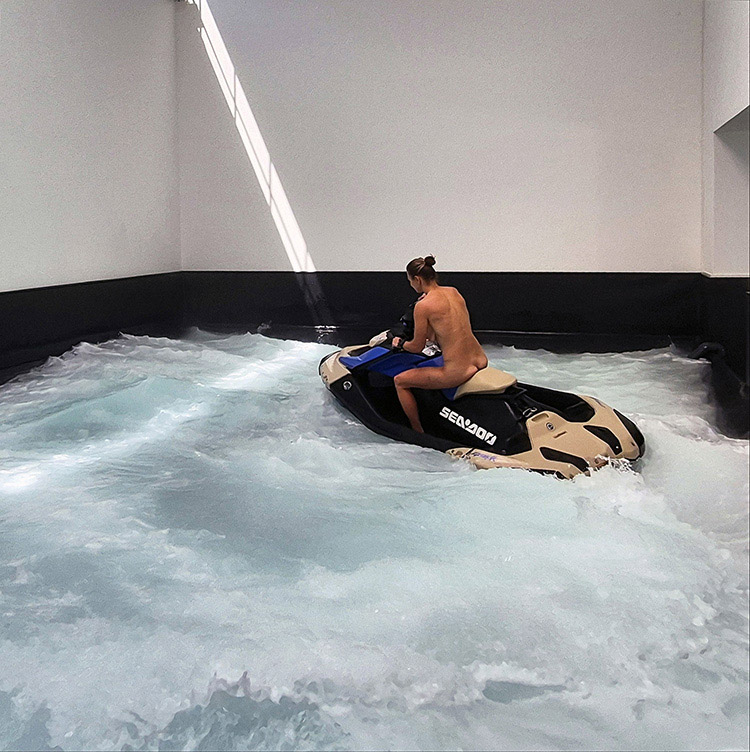
Florentina Holzinger, Seaworld Venice, 2026.
SIf there was one national pavilion that left a lasting impression during the professional days - before twenty-five of them temporarily closed their doors in protest the continued presence of the Russian and Israeli pavilions - it was Austria’s, featuring the performance artist Florentina Holzinger, who choreographed the performances. Nudity is de rigueur, as is often the case in art, and the radical nature of the performances evokes Viennese Actionism from the last century, even though the world has changed significantly. At the entrance to the pavilion, the clapper of a suspended bell is embodied by a performer who violently tolls the bell with her body. The exhibition’s title, Seaworld, underscores our total dependence on the liquid element. Thus, recycled urine from the public helps to fill a glass cube evoking escapology, as another performer, equipped with a regulator, is submerged within it. Meanwhile, another rides a jet ski inside a flooded room. Such extravagances -open to interpretation though guided by the location, as Venice is renowned for its floods among other excesses - are widely shared on social media, where the spectacle is never-ending.
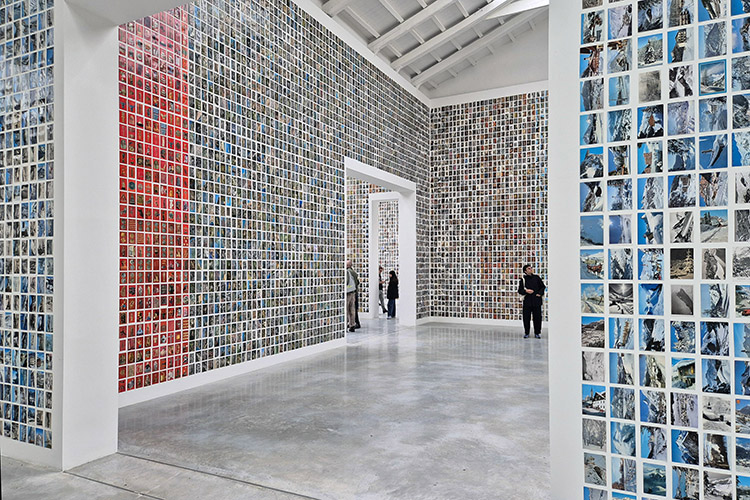
Oriol Vilanova, Los restos, 2026.
The walls of the Spanish pavilion were entrusted to Oriol Vilanova, who covered them entirely with postcards. He collects them compulsively, regularly scouring flea markets from Barcelona to Brussels. And it was with equal obsession that he hung them in a grid, a well-known display technique in contemporary art. Los restos, the pavilion’s title, is tinged with a sense of nostalgia for the popular cultures long embodied by these quintessential tourist souvenirs from the world of yesteryear. The display method is interesting because the postcards are grouped by subject but also by color. It is as if they were meant to be viewed as a whole, like a mosaic, without obscuring the individual scenes for those approaching them. It is therefore an installation that is as conceptual as it is immersive, and its perception depends on the viewing distance.
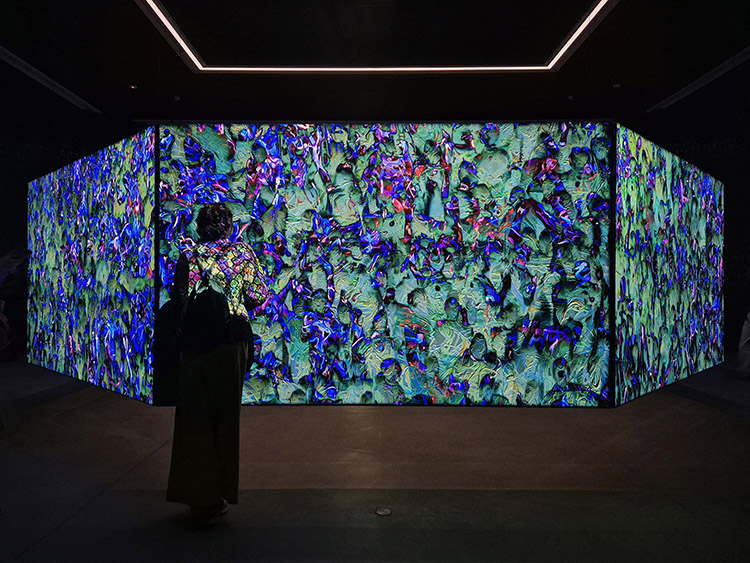
Khaled Sabsabi, Conference of one’s self, 2026.
Lebanese-born Australian artist Khaled Sabsabi, meanwhile, establishes a link between the Giardini and the Arsenal by presenting two monumental installations: Conference of one’s self at the Australian Pavilion and Khalil in Koyo Kouoh’s exhibition Minor Keys at the Corderie. The first is octagonal and is experienced from the outside, while the second is circular and is experienced from the inside. Their walls, presented in relative dimness, share the common feature of having been painted before being enhanced with projected moving images, to the extent that the two textures intertwine. In both spaces, we are encouraged to engage in dialogue and find serenity. Thus, right at the entrance, the Australian pavilion is described as a “place for creativity, inquiry and exchange”, while at the threshold of the international exhibition, Koyo Kouoh addresses us as follows: “Take a deep breath, Exhale, Drop your shoulders, Close your eyes.”
At the arsenal
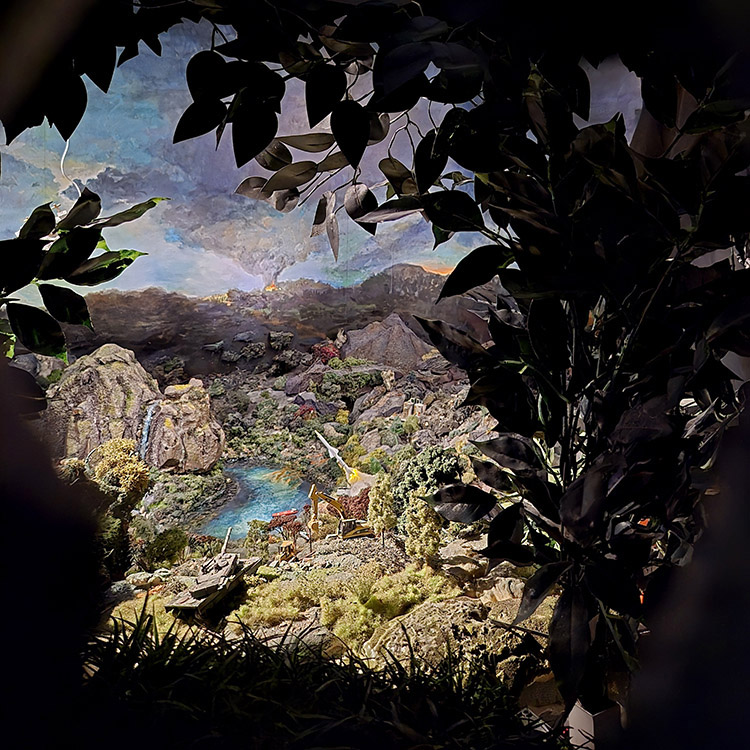
Norton Maza, Inter-Reality, 2026.
While the historic pavilions are clustered within the Giardini, more recent ones are located at the Arsenale. Take the Chilean pavilion, for example, where visitors must remove their shoes to enter the somewhat sterile area of the multi-part installation Inter-Reality. In the center, a minimalist-looking white polygonal structure intrigues the public, while the highly realistic sculpture of a man observing the interior through a peephole encourages visitors to do the same. There we discover a diorama of a seemingly bucolic landscape - until we spot military vehicles. This solo exhibition by Norton Maza speaks volumes about the constant interplay between reality and fiction in our media-saturated environments. Here, the container reveals nothing of the content it holds, while the three-dimensional representation of a plausible landscape could just as easily be the scene of manipulation. One inevitably thinks of the images of conflict that the governments of warring countries bombard us with to shape our opinions. Wars today are being fought on all fronts, even in art.
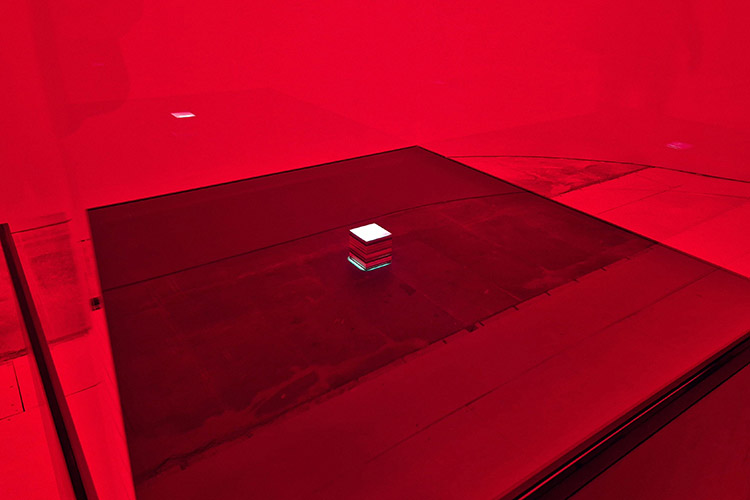
Alfredo Jaar, The End of the World, 2023-2024.
In his installation The End of the World, presented in the In Minor Keys exhibition at the Arsenal, Alfredo Jaar does not focus directly on wars, but rather on what often causes them: the minerals over which companies and states compete. He has selected about ten of them (cobalt, coltan, copper, germanium, lithium, manganese, nickel, platinum, rare earths and tin), which he documents at the entrance to the work’s monumental space. The space is literally bathed in a red light reminiscent of a darkroom - a space of revelation from the past - given that the Chilean artist has also worked in photography. At the very back of the monochromatic setting that lends such a distinctive atmosphere to this environmental artwork, a small cube is displayed as is customary in museums. It contains the ten critical raw materials, arranged in layers. Since some of these are also found on the moon, our satellite becomes a future site of desire.
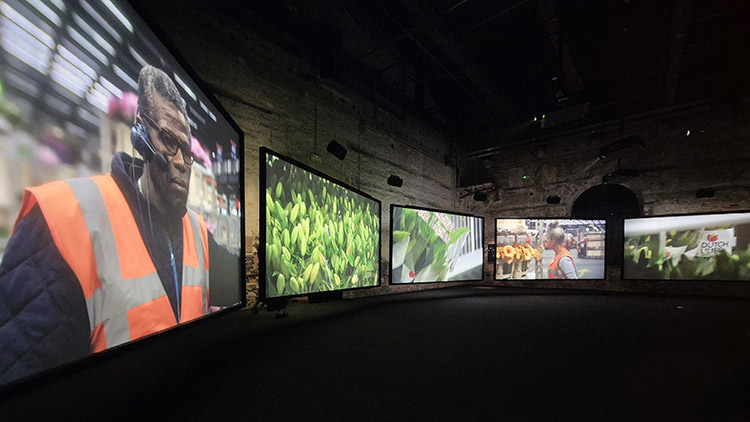
Eric Baudelaire, Death Passed My Way and Stuck This Flower in My Mouth, 2026.
Another monumental installation, both in terms of the number of video projections - five arranged in a semicircle - and its sheer size: Death Passed My Way and Stuck This Flower in My Mouth by Eric Baudelaire, inspired by Luigi Pirandello’s play The Man with the Flower in His Mouth. The scene takes place in the vast Aalsmeer flower market in the Netherlands, where humans and robots work in harmony to manage the mechanized handling of perishable living matter. The perfection of the choreographed ballet stands in stark contrast to the ephemeral nature of cut flowers. And what of the carbon footprint of such a global enterprise transporting petals of various colors? As for the workers, one can imagine them just as skillfully orchestrated as the autonomous carts by a computer system designed around a single concept: productivity. An organization that resonates perfectly with that of the Venice Biennale, which had to transport the numerous works to present them for a few months before sending them back to their various destinations.
From Collections to Palaces
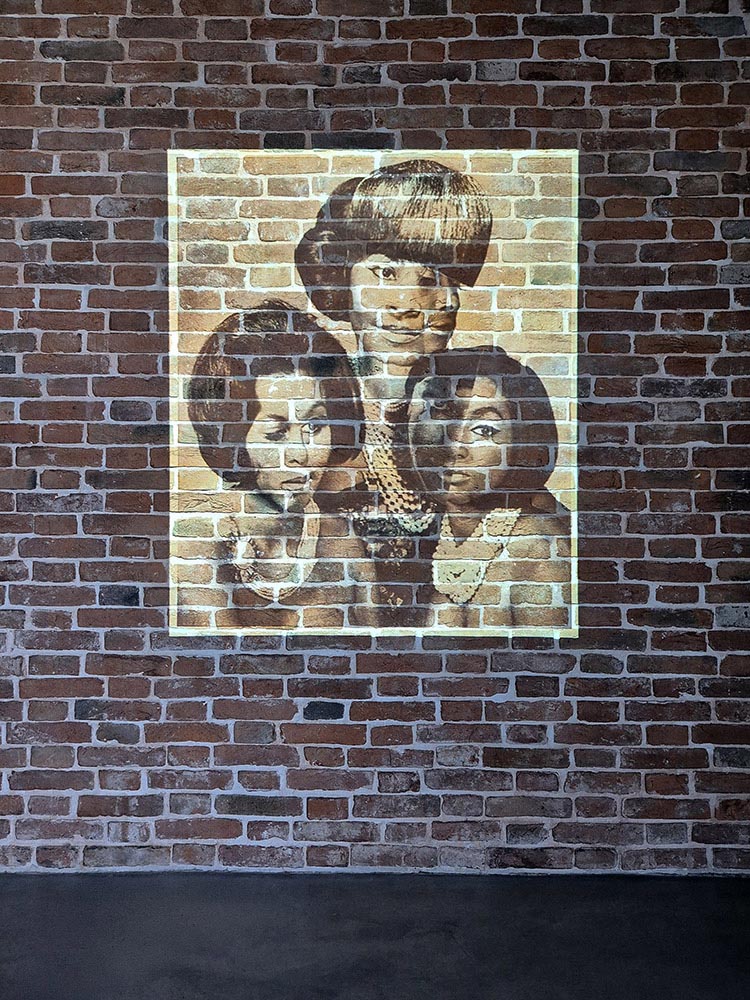
Lorna Simpson, Walk with me, 2020.
The Venice Biennale also offers an opportunity to visit public and private institutions such as the Pinault Collection, which is presenting Lorna Simpson’s solo exhibition Third Person, a continuation of the show held at the Metropolitan Museum of Art in New York last year. Oscillating between the photographic and the pictorial, the American artist draws inspiration from African American culture, which magazines like Ebony and Jet have documented through images over the decades. Thus, in the video loop Walk with Me, three strangely recomposed faces of African American women coexist while flirting with the idea of hybridization. A collage that today constitutes an act of resistance through its very making, in response to both the immediacy and the perfection of generative artificial intelligence applications. It should be noted that its projection, directly onto one of the brick walls of the Punta della Dogana, lends it a new materiality. The image gains both in complexity and texture, two concepts central to Lorna Simpson’s aesthetic.
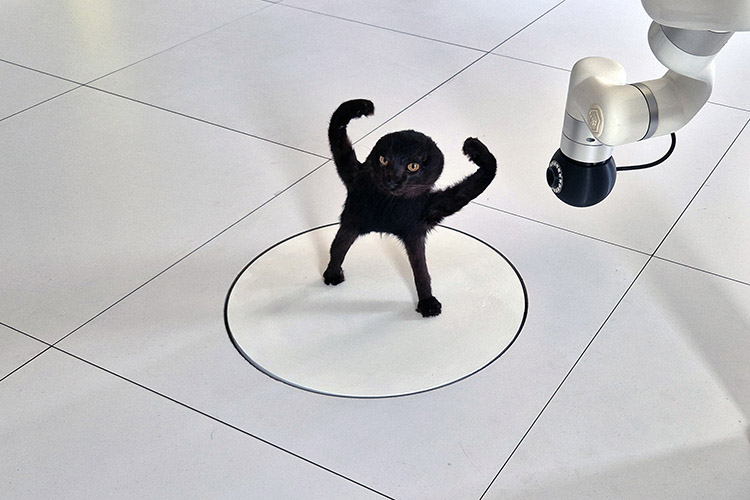
Eva & Franco Mattes, Cursed Cat, 2025.
The Palazzo Franchetti is one of Venice’s must-see palaces. Among the exhibitions on view there, Rage Bait by Eva & Franco Mattes is organized by the Autotelic Foundation. Active since the mid-1990s, the duo has continuously scoured the internet to extract ideas and forms, which they then amplify in art centers or galleries. So, it comes as no surprise that the figure of the LOL cat frequently appears in their work. This is the case with the site-specific sculptures of Cursed Cat that punctuate the exhibition route. The series originated from a 2008 Getty Images photograph documenting a shooting, with a black cat in the foreground - a creature that according to superstition, brings bad luck. Digitally altered in its posture, the feline reappeared a decade later to finally become a meme in Russia, and then internationally. Such is the nature of the internet - especially in its social media form - and of art, which act as amplifiers of societal phenomena. This is also true of this 61st Venice Biennale, which is more political than ever.
Articles
- 61st Venice Biennale
- Ososphère
- Paris Photo
- Art, technology and AI
- Immersive Art
- Chroniques Biennial
- 7th Elektra Biennial
- 60th Venice Biennial
- Endless Variations
- Multitude & Singularity
- Another perspective
- The Fusion of Possibilities
- Persistence & Exploration
- Image 3.0
- BioMedia
- 59th Venice Biennale
- Decision Making
- Intelligence in art
- Ars Electronica 2021
- Art & NFT
- Metamorphosis
- An atypical year
- Real Feelings
- Signal - Espace(s) Réciproque(s)
- On Combinations at Work
- Human Learning
- Attitudes and forms by women
- Ars Electronica 2019
- 58th Venice Biennale
- Art, Technology and Trends
- Art in Brussels
- Plurality Of Digital Practices
- The Chroniques Biennial
- Ars Electronica 2018
- Montreal BIAN 2018
- Art In The Age Of The Internet
- Art Brussels 2018
- At ZKM in Karlsruhe
- Lyon Biennale 2017
- Ars Electronica 2017
- Digital Media at Fresnoy
- Art Basel 2017
- 57th Venice Biennial
- Art Brussels 2017
- Ars Electronica, bits and atoms
- The BIAN Montreal: Automata
- Japan, art and innovation
- Electronic Superhighway
- Lyon Biennale 2015
- Ars Electronica 2015
- Art Basel 2015
- The WRO Biennale
- The 56th Venice Biennale
- TodaysArt, The Hague, 2014
- Ars Electronica 2014
- Basel - Digital in Art
- The BIAN Montreal: Physical/ity
- Berlin, festivals and galleries
- Unpainted Munich
- Lyon biennial and then
- Ars Electronica, Total Recall
- The 55th Venice Biennale
- The Elektra Festival of Montreal
- Digital practices of contemporary art
- Berlin, arts technologies and events
- Sound Art @ ZKM, MAC & 104
- Ars Electronica 2012
- Panorama, the fourteenth
- International Digital Arts Biennial
- ZKM, Transmediale, Ikeda and Bartholl
- The Gaîté Lyrique - a year already
- TodaysArt, Almost Cinema and STRP
- The Ars Electronica Festival in Linz
- 54th Venice Biennial
- Elektra, Montreal, 2011
- Pixelache, Helsinki, 2011
- Transmediale, Berlin, 2011
- The STRP festival of Eindhoven
- Ars Electronica repairs the world
- Festivals in the Île-de-France
- Trends in Art Today
- Emerging artistic practices
- The Angel of History
- The Lyon Biennial
- Ars Electronica, Human Nature
- The Venice Biennial
- Nemo & Co
- From Karlsruhe to Berlin
- Media Art in London
- Youniverse, the Seville Biennial
- Ars Electronica, a new cultural economy
- Social Networks and Sonic Practices
- Skin, Media and Interfaces
- Sparks, Pixels and Festivals
- Digital Art in Belgium
- Image Territories, The Fresnoy
- Ars Electronica, goodbye privacy
- Digital Art in Montreal
- C3, ZKM & V2
- Les arts médiatiques en Allemagne
- Grégory Chatonsky
- Le festival Arborescence 2006
- Sept ans d'Art Outsiders
- Le festival Ars Electronica 2006
- Le festival Sonar 2006
- La performance audiovisuelle
- Le festival Transmediale 2006
- Antoine Schmitt
- Eduardo Kac
- Captations et traitements temps réel
- Maurice Benayoun
- Japon, au pays des médias émergents
- Stéphane Maguet
- Les arts numériques à New York